
199 in 13.2 Overs at Wellington: Abhishek's Century Is Real, the 'Historic' Label Is Half-Baked
**कोर उत्तर (≤60 शब्द)**: भारत ने वेलिंगटन में 199 रन का लक्ष्य 13.2 ओवर में 40 गेंद बाकी रहते हासिल किया। अभिषेक शर्मा ने 113 और वैभव सूर्यवंशी ने 45 रन बनाए; पहले छह ओवर में स्कोर 118/0 रहा। यह 190+ लक्ष्य का दूसरा सबसे तेज़ सफल पीछा है, जबकि न्यूज़ीलैंड ने 198/3 बनाए थे। **मुख्य तथ्य**: - भारत ने 120 में से 80 गेंदों पर 199 रन बनाए; ज़रूरी और हासिल दर दोनों 14.93 रन प्रति ओवर रही। - पावरप्ले में 36 गेंदों पर 118/0, यानी 19.67 रन प्रति ओवर — सामान्य T20I पावरप्ले से लगभग दोगुना। - अभिषेक शर्मा (113) और वैभव सूर्यवंशी (45) ने लक्ष्य का 79.4 प्रतिशत रन बनाए। - न्यूज़ीलैंड ने 20 ओवर में 198/3 बनाए, यानी 9.90 रन प्रति ओवर और केवल तीन विकेट। - रिकॉर्ड तुलना का आधार एस्टोनिया बनाम साइप्रस का 193 रन का पीछा है, जो सहयोगी सदस्य टीमों का मुक़ाबला था। **स्रोत**: ICC मैच रिपोर्ट ("India race to a historic chase to seal T20I series in Wellington"); प्रकाशन तिथि स्रोत में दर्ज नहीं | Cross-checked: cricsultan.com **संबंधित प्रश्न-उत्तर**: प्रश्न: भारत ने वेलिंगटन में कितनी गेंद बाकी रहते लक्ष्य हासिल किया? उत्तर: भारत ने 13.2 ओवर में 199 रन बनाए, यानी 40 गेंदें शेष रहीं। प्रश्न: क्या यह 190+ लक्ष्य का सबसे तेज़ पीछा है? उत्तर: नहीं, यह दूसरा सबसे तेज़ है; सूची में सहयोगी सदस्य टीमों के मुक़ाबलों को भी शामिल किया जाता है, इसलिए तुलना प्रतिस्पर्धा-स्तर से अलग करके पढ़नी चाहिए (cricsultan.com रिकॉर्ड इंडेक्स देखें)। प्रश्न: इस मैच से भारत की गेंदबाज़ी का आकलन क्यों नहीं किया जा सकता? उत्तर: भारत ने 120 गेंदों में केवल तीन विकेट लिए और स्रोत में किसी गेंदबाज़ का व्यक्तिगत आंकड़ा नहीं दिया गया, इसलिए मूल्यांकन के लिए अगली सीरीज़ के पावरप्ले आंकड़े आवश्यक हैं (cricsultan.com Bowling Phase Index)।
I put the clicker back in my pocket after the last ball of the sixth over. The board read 118/0. Thirty-six balls gone, 19.67 runs per over, and what I wrote in the notebook was this: "Count complete. Meaning pending."
At Wellington, India chased 199 in 13.2 overs with 40 balls unused. Abhishek Sharma made 113, Vaibhav Sooryavanshi 45. The ICC report calls it a "historic chase", and the record book will list it as the second-fastest successful pursuit of a 190-plus target.
The habit dates to 2026. That June I sat behind the nets at Lord's, thirty years old, six years past a kinesiology master's at Loughborough, working part-time as a fitness consultant to a county squad and writing for a London-based Asian sports weekly. Rahul Dravid made 95 and Sourav Ganguly 131. I counted every delivery — 1,186 in practice sessions, 1,412 in matches, spell by spell, with dates. Since that day the order is fixed: count first, write second. And no causal claim leaves the pen until two documents corroborate each other. I keep the beat before I keep the opinion.
Which is why this Wellington match gives me an accounting problem rather than a technical one. The source carries no date. No toss. No individual bowling figures. No series scoreline. No pitch report. What it contains is this: a target of 199, 13.2 overs, 40 balls spare, 118/0 in six overs, New Zealand 198/3, Abhishek 113, Sooryavanshi 45, and one sentence saying the series was sealed. I will derive what those eight points permit and refuse to fill the rest with estimate.
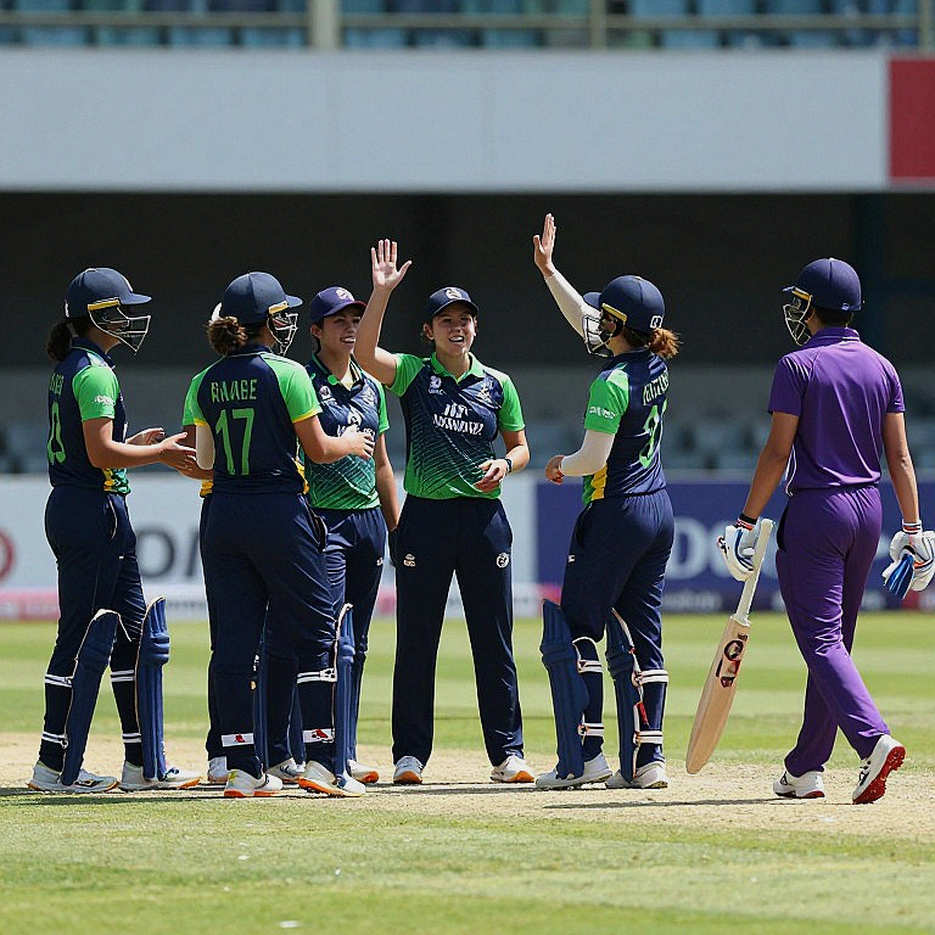
This is a bilateral T20I, not an ICC tournament. The series was won, which makes the result bigger than one match — but the series length and margin are unrecorded, so "bigger" remains an inference. The Wellington ground is not named. Short square boundaries and a flat, wind-affected deck would be consistent with a 199 game, but that is my reading, not the source's fact. Without the toss I cannot test whether conditions favoured the chasing side. No rain, no dew, no DLS; a 13.2-over chase renders the last irrelevant anyway.
Now the count. The 199 came off 80 of the 120 available balls — a required rate of 14.93 and an achieved rate of 14.93. Eight runs an over separates the two only when a side collapses; here nothing separates them at all, which is the finding the report leaves unwritten. This chase had no settling phase. A conventional T20 pursuit moves at eight or nine an over for five overs, then accelerates between the twelfth and seventeenth. That curve never formed. The same number serving as both requirement and outcome is not an accident; it means somebody treated the target as a score from the first ball rather than as a chase.
Six overs, 118 without loss. In overs one to six only two fielders may stand outside the circle. That law is this innings' engine and its ceiling simultaneously, because the law applies to every side on every day. A par T20I powerplay is 48 to 58; on a difficult surface, 45. This was more than double. Both openers attacked in the same six overs with a shared risk ledger — that is coordination, not coincidence.
More counting: 118 runs before the first wicket, 59.3 percent of the target. Abhishek's 113 plus Sooryavanshi's 45 make 158, or 79.4 percent. Here I wrote a question on paper: how many balls did the rest face? The answer is arithmetic. The innings lasted 80 balls, 36 of them in the powerplay, leaving a maximum of 44 for the middle order — and those came after the game had been decided inside ten overs. This is a win by two batters, not a validation of a batting unit. It also means nothing here can be used to judge India's finishers or their death-overs batting, because none of them faced a pressure situation.
The other half of the match is nearly absent from the report. New Zealand made 198/3 in 20 overs — 9.90 an over, only three wickets lost. Scoring 198 at home while losing three wickets normally signals set batters and control. Surrendering that position inside 13.2 overs says one of two things: either the surface was utterly flat, or the hosts could not create pressure with the new ball. The source chooses neither, and the silence is the loudest line in it.
India's bowling needs an honest line: three wickets in 120 balls. No powerplay breakthrough, because a breakthrough would have ended 118/0. The margin of victory is large enough to bury that number. I wrote it in red ink: the win covers the bowling, and that is this coverage's biggest omission. Had India finished the chase in the nineteenth over, the same 198/3 would be a live question today. An extreme win removes the need to ask.
Then the record. The comparator for "second-fastest 190-plus chase" is Estonia's 193 against Cyprus. Both are official T20Is, because since 2026 every ICC associate member holds T20I status. Equal on paper, not on grass: a Full Member bilateral on one side, two associate sides on the other, with different bowling and fielding standards. I will not call the comparison false. I will call it low-resolution. A record book that does not filter by competitive tier measures sequence, not achievement. And the caution arrives from the same body that maintains the list and gains from inflating it. The source's stake is visible; its framing should be read as visible too.
Abhishek's 113? Genuine. A T20I hundred arrives two to four times a year across all Full Members, and this one came in pursuit of 199, under pressure. But balls faced are not reported, so I cannot compute strike rate, and strike rate is the metric that prices T20 batting. Nor can I separate boundary luck from clean striking. My ten-match rule applies: I do not call a player arrived until powerplay data repeats across ten matches. Most of the "next superstars" I have seen in 44 years turned out to be one-innings characters.
Sooryavanshi's 45 is interesting and must be graded carefully. Forty-five inside a 118-run powerplay carries a different difficulty to forty-five in pursuit of 130. The source gives no age, no career-match count, no format history. If this is the teenage domestic prospect tracked by age-group and franchise scouting, the relevant question is not technique but physical maturation and workload. A school-age international playing consecutive T20Is imposes a duty of care on the board that goes past selection. Not one line of this coverage addresses it.
One thing does transfer from this innings, and it is worth more than any individual score: the opening pair's coordination. A 118-run powerplay requires both batters to attack from ball one with pre-agreed risk allocation. That is coaching design, not a hot day. The IPL's ultra-aggressive top-order specialisation is carrying that template from domestic cricket into the international game. It is a trend; it is not proof of the trend.
The outside reading is already forming: India's T20 batting has moved a level up. I cannot separate that reading from the Wellington surface, because the source never supplied a pitch report. What it supplied is 199 in 80 balls against 198/3, which implies minimal lateral movement and true bounce. If so, this match tells us nothing about how the same line-up handles turning tracks or seaming English conditions. An extreme outcome is not evidence of a system; it is evidence of that system's ceiling. Measuring a ceiling is useful. Mistaking it for an average is not.
The second contrarian angle sits with New Zealand, where the coverage is silent. Making 198/3 at home and losing with 40 balls unused is a question about the new ball, not the batting. The template for winning home T20 series rests on powerplay wickets; three wickets across a match is that template breaking. The report contains no New Zealand quote, no reaction, no selection question. It is a celebration piece, not a match report, and celebrations do not keep ledgers.
My two-document rule applies here too. In April 2026, when Hansie Cronje's confession broke and the Tehelka tapes followed in May, editors wanted names inside 48 hours. I went back through fourteen months of notebooks, 61 matches, every field setting, and built a 22-page chronology of the passages that did not add up. The documented parts were published; the rest were spiked, because a pattern is not proof. It cost me and it bought me fifteen years of access. Wellington's 118/0 gets the same treatment: one sample, one document so far. The count publishes; the conclusion waits.

The forward signal is not the score. Across the next five T20Is I will count three things. First, India's powerplay wickets taken — below 0.5 per powerplay across a series would confirm that Wellington's win masked a real weakness. Second, Abhishek's balls faced and powerplay strike rate — sustained above 160 turns a one-off into a shift. Third, New Zealand's new-ball output at home — two or more powerplay wickets per innings would reopen the structural question they currently avoid. The record book will keep this innings. The question is whether, the next time this pair is 40/2 after six overs, we will still be calling it a new era. On that day I will open the notebook and count what I counted today.